


Lately: I had a baby! 10 out of 10 would recommend, if you’re into that kind of thing. She’s perfect. My husband wrote an essay about her, which was very sweet and made me cry. You should read it, too. … Okay, let’s get to books. That’s why we’re here.
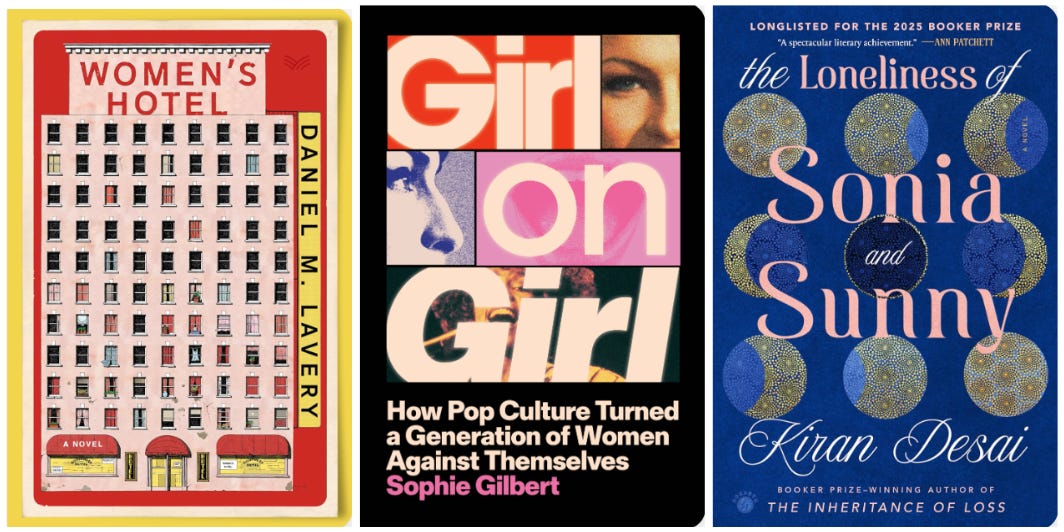
everything I read in February
The other day, my husband and I stopped at the library. We both had books to pick up. I waited outside with the baby while he went in to grab what was waiting for us. When he came out, he laughed. “I thought there was a mistake,” he told me. “You never read books by male authors.”
The book in question was Ashland, by Dan Simon, which I’d read a review of … somewhere. I haven’t opened it yet, and I’m not going to do a full accounting of my recent reads to see if the numbers bore out Jesse’s claim — but the spirit behind it is certainly correct. I do feel like I read more authors who are women, in part because, painting broadly, I find that women more often write about the subjects that interest me: family, friendships, generational sagas. Or maybe they create characters who compel me. Or maybe they just tend to write more often about women, and I like reading about women, and it’s as simple as that.
In February, I read one book by a man: Women’s Hotel, by Daniel Lavery. This is, quite obviously, a book about women — specifically, women living in one of New York’s residential hotels in the 1960s, at a time when that way of life was tapering off. This book had been sitting on my shelf for over a year, and why I grabbed it in my 38th week of pregnancy, I cannot say; maybe I subconsciously knew it would provide the laugh I needed during a time of deep discomfort. (I actually finished this book as I waited to leave for the hospital to be induced!)
“Women’s Hotel” is very funny. Lavery’s narration is tongue-in-cheek, absurdly descriptive and keenly observed. He has an eye for his characters’ quirks — but at times, he reduces these women to nothing more than their quirks. The story is set over a short period of time in which nothing really happens, but we learn all about the strange and scheming women who take rooms at the Biedermeier Hotel, their bad haircuts and marriage plots and beloved stray cats. I laughed out loud over and over again. I enjoyed the book immensely. And since I finished, I keep thinking: I’d love to read the version of this story written by a woman.
Lucky for me, the other two books I read last month fit my usual pattern. After a long wait, I finally got my hands on The Loneliness of Sonia and Sunny, by Kiran Desai, which was on practically every year-end list for 2025 and was longlisted for the Booker Prize. It’s a doorstopper of a book; I guarantee it weighed more than my 50th-percentile baby did when she was born. And for me, at least, it wasn’t the quickest read; I struggled to get into the story, and then the book’s due date loomed, so I ended up buying it. It just didn’t feel like a story I should abandon, but in hindsight, I’m not sure it was worth the price tag. Even once I was immersed in my own copy and halfway through the long arc of the story, I struggled to connect with the characters’ motivations; the way they dragged their feet at almost every task they undertook and goal they set drove me batty. Maybe I’m being too hard on them. Maybe I just didn’t have the stamina for 700 pages. Either way, my copy of this book was dropped at a little free library soon after I finished.
In a bit of a pivot, I followed up “Sonia and Sunny” with Girl on Girl: How Pop Culture Turned a Generation of Women Against Themselves, by Sophie Gilbert. This, like “Women’s Hotel,” is a book I’d been meaning to read for months — and it was by far the best thing I read in February. It’s a nostalgia tour of ’90s and aughts pop culture, told through the lens of the misogyny and hyper-sexualization that pervaded entertainment and media. My favorite detail: The May 2008 cover of Esquire featured a close-up photo of a topless Jessica Simpson, with text that read: “We shot this image to catch your eye so you will pick up this issue … and immerse yourself in the most gripping story you will read this year.”
The story in question? “The Things That Carried Him,” by Chris Jones, which was, when I was in journalism school from 2009 to ’11, one of the stories that nearly every professor referenced at least once (or 10 times) when teaching about narrative writing and reporting. It’s one of the best stories ever to be published in Esquire, a magazine that was for years known for publishing the best longform stories there were to tell — and for some reason the people men in charge believed we needed the top of Jessica Simpson’s boobs to entice us all to read it.
That’s all to say: “Girl on Girl” was very much my jam, as far as cultural criticism goes.