

everything I read in March
This is not a newsletter about books. It's a newsletter about opportunity costs.

Lately: I’m keeping a baby alive. The baby in question happens to be quite agreeable, and she likes to sleep at the hours when her parents want to sleep, which explains how I am typing this newsletter to you all. Maybe I’ll be back in a regular routine here soon. But probably not!
everything I read in March
Before leaving for the hospital to be induced, I packed for a long labor. My doctor warned me things could move slowly, that it would be at least a day, and maybe two or three, before we met our daughter. So I packed a book, of course. When I think back to that strange, impatient evening, I remember staring at the bookshelf in my bedroom, considering some of my most beloved authors. I have an Alice McDermott paperback or two that I haven’t yet read, and I’d picked up Ann Patchett’s State of Wonder — another “I should read this someday” title — in a Little Free Library. But I wasn’t quite thinking straight as I sorted through everything I needed to pack while the clock crawled toward my midnight check-in. How many pairs of pajamas? Would I want shower shoes? Was I silly to have purchased my own pack of one-time-use underwear, rather that just using whatever the hospital would offer?
Here’s what happened, then: I grabbed my most recent library check-out, Venetian Vespers, by John Banville. I’d read about it somewhere, who knows where, and seen such buzzwords as “literary” and “historical fiction,” the kind of reading-related catnip that tends to make me look past crucial details like scope and plot and setting. Can you guess where this is going? “Venetian Vespers” was not a very good book.
And here’s the silliest part of the story I’m telling you, about the quick moments of reading I stole during my daughter’s first weeks of life: I didn’t even read “Venetian Vespers” in the hospital. Turns out, I was in early labor when I arrived, and then my daughter’s heart did what one kind nurse described as a “cha-cha.” A taciturn on-call doctor described it less colorfully: It was an arrhythmia. When my (much less taciturn) doctor arrived, she decided it would be better to get the baby out quickly. In a few hours, after sunup. And then no, never mind, immediately. There was a spinal block, a c-section, and barely six hours after I’d stared at my bookshelf and made the wrong choice, there was a baby. A perfectly healthy baby with a great heart, it turns out.
But there were no pages read in the hospital. So why didn’t I make a better choice when I got home? Let’s blame the hormones.
“Venetian Vespers,” if you’re still curious, features the most detestable narrator I’ve encountered in years. It’s a bit of a who-done-it — or, more precisely, a where’d-she-go — set in Venice in 1899. Here’s what it’s like to read it: The detestable main character bumbles around, and you know from the start he’s too self-absorbed to realize he’s being preyed upon, but you aren’t even sad he’s being preyed upon, because yuck. You are, at least, confused, which is a thing you should feel when you’re reading a mystery. But then, with about 30 pages to go, all your questions are answered when a random character arrives unannounced and explains the situation to the idiot narrator. And that is that. The end. I can’t believe I gave up three or so hours of staring at my daughter to ingest this story.
When talking about kids and television time, the economist and author Emily Oster often references the opportunity cost of clicking the power button on the remote. I was once an econ major, so it no surprise that this framing makes so much sense to me. In short: If it’s raining outside, or if your kid is sick and stuck on the couch, the opportunity cost of “Bluey” is pretty low — but if it’s a perfect 70 degree spring day, the cost is off the charts.
My baby isn’t old enough to ask to watch TV — though she has nonconsensually been in the room for a whole lot of college basketball — but even so, the opportunity cost lens of parenting is fully lodged in my craw. I thought of it immediately when I closed “Venetian Vespers” — GARGANTUAN opportunity cost, guys — and ever since, I’ve been pricing out the choices I make with my time. If I’m going to work out, I should focus and activate my core and get the most out of those 50 minutes that I can. If I’m going to scroll my phone, I’d better be aware of the value of those minutes I’m putting through the mental shredder.
If I’m going to read, I need to check out better books — or I need to learn something. I was better at the latter than the former in March.
For instance, I hated this extremely confusing manual for how to build a space-age outdoor TV stand. Hated it almost as much as I hated “Venetian Vespers.” It turned me into an unlikeable protagonist … but I did learn how to build a wind-resistant TV mount, which was pretty ideal given that our patio TV blew over and shattered during the baby’s second week of life. Opportunity cost: low. I can’t keep spending $200 a week on televisions.
Some more high-reward, if eccentric, reading: the fabric content of H&M’s baby clothing, opinions about what you should do when you have two glasses of wine and need to pump, approximately 27 Reddit posts about how often five-week-old babies should poop and several reviews of the Frida Baby Windi. We talk a lot about bodily functions these days. My emotional state is directly correlated to the time elapsed since my daughter’s last bowel movement. “Toot” is my most-used word, and in March I felt I needed to know everything about tooting and baby digestion: the smells and the frequency and the way her face goes from its usual pale to something like crimson in a matter of milliseconds.
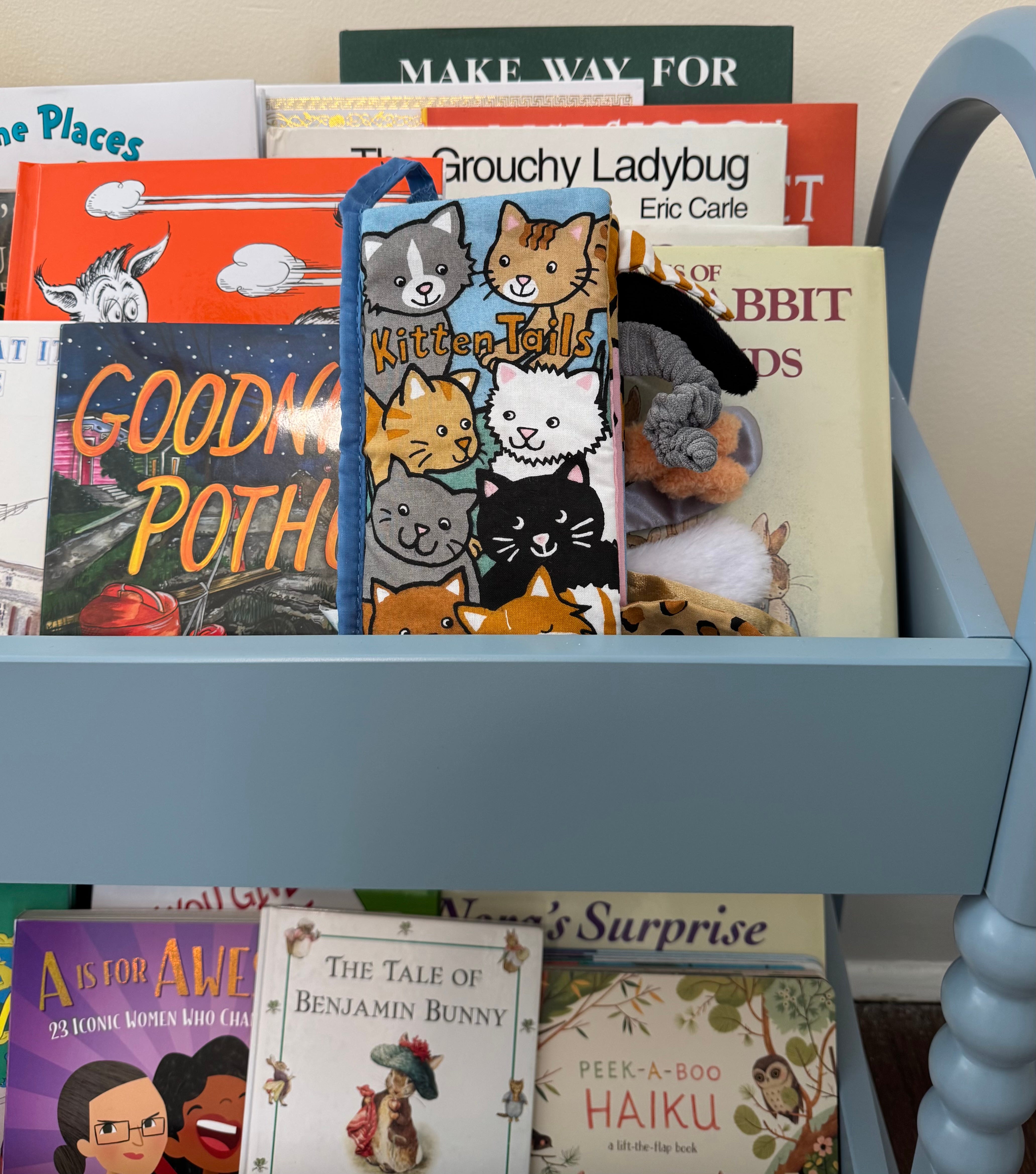
Sometimes, though, the baby’s insides are peristalsis-ing along just fine, and she isn’t in the midst of eating or sleeping, and when that lines up, we read. Reading to a one-month-old is aspirational, insane and an exercise in practicing a wide range of odd voices. It’s so fun, even if she does spend more time staring at me than looking at the pictures. (I’m flattered.) In the last week of March, we spent a lot of time with a little finger-puppet board book called Mommy and Me, which leaves something to be desired when it comes to plot and character development, but which makes my daughter’s eyes go wide whenever I wiggle the little plush elephant face with my index finger.
If her darting eyes — which can see a whopping 12 inches into the foreground — were any indication, the baby did love The Jumblies, a wacky nonsense poem of a book that my best friend loved when she was a kid and then delivered to us in the hospital room. We didn’t get around to opening it for a few weeks, and for that I’m deeply sad, given that it’s an instant mood-lifter. It seems like the kind of book we’ll read at least weekly.
And last but certainly not least, there’s Nora’s Roses, by Satomi Ichikawa. The Nora books are an illustrated series published in the 1980s and ’90s, and I adored them when I was a little girl. They’re beautifully illustrated — so beautiful, I ripped up a copy of “Nora’s Stars” and framed some of the pages as artwork in the nursery — and heartwarming. “Nora’s Roses” just happened to be the one Nora book I could reach while sitting in the glider, rocking the baby, and so it was the first one we read. In the story, Nora is sick, and she watches friends and acquaintances pick roses off the bush in her window … until the roses come to her and take her and her stuffed animals off to a party. Every book in the series hits that perfect note of little-kid fantasy, and until I re-read it, I’d forgotten how I used to daydream about flowers come to life and tea parties with my favorite stuffed rabbit. I wonder how many hours of my childhood were given over to those daydreams. I can’t wait for my daughter to lose herself in those stories someday, so why not plant the seed early? Why not make her wonder, when first learns what a rose is in nature, if it might dance its way to life?
And the opportunity cost? Zero. I’d read to her all day if I could.


an unsolicited recommendation
Up above, I mentioned framing book pages in the baby’s nursery, and I cannot recommend this enough. Art is expensive! But a used copy of “Nora’s Stars” and a used copy of “Madeline” set me back about $9 total, and then all I had to do was destroy the binding and ship my favorite pages off to Framebridge. The finished product is prettier than anything I’d have bought on Etsy.
After reading your comment on The Jumblies I had to purchase for our friend having twin boys…it is perfect Congratulations to you and Jesse💕
Love the idea to Framebridge pages from your favorite children's books for the nursery!